Overcrowding by the Numbers
In primary school, we learn that math is immutable and irrefutable. One plus one is always two. However, statistics are another matter, especially when they’re used to justify taking local resources away from neighborhood schools.
We’ll use the situation at Haugan Elementary as an example of how numbers can be manipulated at the district level to prop up arguments against investing in neighborhood schools. While CPS’s portfolio team gave no rationale for denying Haugan’s recent request to colocate in nearby space recently vacated by the dissolution of ASPIRA’s charter school, they appear to be using flawed math and penalizing the school for serving the community.
CPS’s Space Utilization Formula Doesn’t Make Sense in Practice
As a school advocacy group, we understand that the city needs to apply mathematics to make decisions about space usage across a wide geographic area. But understanding its flaws in real-world scenarios is key to applying formulas in an equitable way.
The fact is, CPS’s space utilization formula pretends that every class can function with the same number of students. But practitioners on the ground know that’s not the case — especially for preschool, special education, and multilingual learners. Not only do these vulnerable populations have increased space needs, but they also can’t be shunted around to fill open spaces as the numbers dictate. For example, if a dual-language school has 15 English-speaking students and 35 Spanish-speaking students all in kindergarten, they can’t just move ten kids over and create two 25-student kindergarten classrooms if they want to truly serve the community in the most equitable way.
Furthermore, the space utilization formula doesn’t take architecture into account. It pretends that every school is brand new, equipped with dedicated space for speech therapists, psychologists, counselors, interventionists. Haugan was built in 1910, requiring the school to subdivide regular classrooms to make space for special services to happen in hallways. Similar to the dual-language example above, this mathematical application serves spreadsheets, not students.
CPS Uses Outdated Logic to Insist Haugan Elementary Isn’t Overcrowded
When CPS told journalists that Haugan is not overcrowded, they used an older formula that doesn’t take into account the new CTU contract, which hinges on smaller class sizes. The numbers also fail to incorporate CPS’s own guidelines to account for schools with pre-K and specialized classrooms and subtracting the cluster and pre-K rooms.
If CPS followed the proper guidelines and the real midpoint of the total classroom average of 25, Haugan’s ideal enrollment would be 905. Given Haugan’s current enrollment of 1,066 children, the school is currently at 118% of its ideal capacity.
CPS Manipulates COVID-Era Data to Make Neighborhood Schools Seem Less Popular Than They Are
In a recent slide deck, CPS’s portfolio office used selective data to portray Haugan as a school with declining enrollment. By employing an overly long timeline and collapsing years into each other, they used a COVID-related dip in attendance to suggest that families are not increasingly choosing Haugan, when in fact they are.
Here are the two timeframes side-by-side:
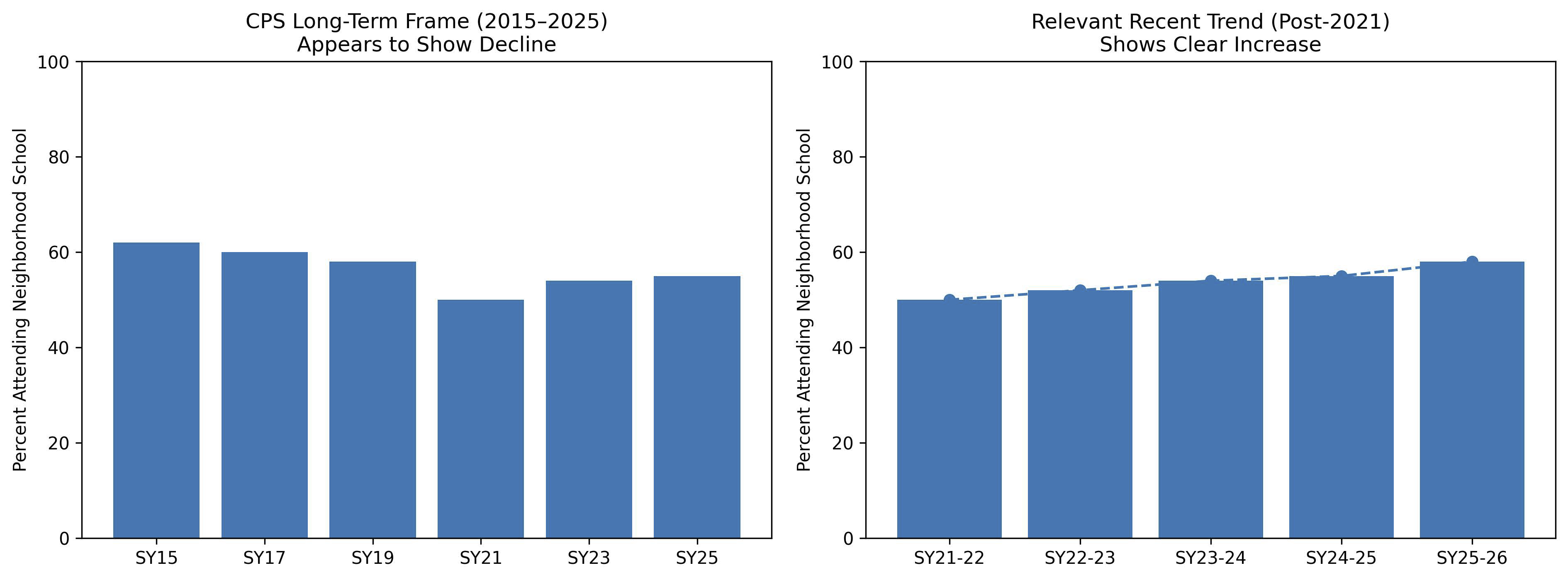
As we all know, COVID had an extreme impact on public schools. According to Public School Review, more than 1.2 million students left public schools between fall 2019 and fall 2023, a 2.5% drop. Enrollment declines have been steepest among the very grades served by Haugan, with kindergarten and middle grades down nearly 6% and elementary by 4%. And yet, Haugan began rebounding faster, showing enrollment gains as early as 2021 into 2022.
And at a time when Chalkbeat finds schools across the west side of Chicago are seeing attendance drops due to ICE raids, Haugan’s increases are even more impressive.
Equitable Math Serves Real Students, Not Politics or Spreadsheets
In order to make occupancy numbers work on paper, CPS’s formula relies on tricks like pre-COVID numbers, outdated classroom size data and squeezing monolingual kindergarteners into bilingual classrooms.
But Haugan meets students where they are, rather than shuffling them around until the math equals out. And that’s why so many families are flocking to neighborhood schools when other institutions fail to meet enrollment thresholds. That’s a formula for success that Unite For Our Schools — Albany Park can stand behind.